
The Quantum Measurement Problem and Mind-Brain Portals
Consciousness is the only way to resolve the Measurement Problem

Almost a century ago, Max Born (1882-1970) published the last major component of the foundation of quantum mechanics: the Born Rule for computing the probabilities of different outcomes of measuring any quantum system. He was eventually awarded the Nobel Prize for it in 1954. It irreversibly brought consciousness into the beating heart of the modern physics, but also thereby created a festering and acrimonious dispute among physicists and philosophers whose positions on this issue remain deeply entrenched.
As I have argued in my two previous posts, mainstream physics cannot cope with consciousness because of collective inattentional blindness. By focusing on what is going on in the physical domain, physicists have collectively turned a blind eye to phenomenal consciousness, leading them to believe that consciousness is ineffable and unmentionable, that it cannot possibly play a role in physics, and almost certainly does not exist anyway.
Unfortunately for physicalist physicists, consciousness is a brute facet of objective reality, an empirical datum, whose obvious existence is established every moment of our waking lives. And quantum physics doesn’t work without it.
Some of the founders of quantum physics - Max Planck (1858-1947), John von Neumann (1903-1957), Erwin Schrödinger (1887-1961), and later Eugene Wigner (1902-1995) - explicitly recognised the central role that consciousness has to play in quantum physics. They did not, however, provide a cogent theory of how consciousness does this. Von Neumann, in particular, was explicitly vague about where the intervention of consciousness occurred in the combined system of measuring instrument plus human brain. This “central, disfiguring blankness” (to quote David Mamet out of context) led physicists to adopt a policy of “Shut up and calculate” (sometimes attributed to Richard Feynman). That is, just use the equations of quantum physics, which have turned out to be breathtakingly accurate and widely applicable, and don’t think about the underlying conceptual foundations. As physicist Sean Carroll has recounted, research into foundational problems of quantum physics was for many years essentially a taboo and, even now, is not well favoured in mainstream physics. Who can blame them? If a valid understanding of the Born Rule involves consciousness, but consciousness is a forbidden concept, then physicists are caught between a rock and a hard place.
A few physicists were dissatisfied with the blanket policy of “Shut up and calculate” but rather than thinking outside the box and boldly imagining how to bring consciousness into science, they went down two roads to nowhere. Some proposed that physical systems just somehow measured themselves and spontaneously executed the Born Rule without human intervention; others concocted a fairy tale of infinitely many parallel universes that split off every time we make a quantum measurement. Henry Stapp (1928-) was arguably the only major physicist to maintain the pivotal causal role of consciousness, although somehow he did not connect this with the Measurement Problem.
Basic ideas
Let us pause for a moment to outline the key ideas here, for any readers who have not yet caught up with the physics of the past hundred years.
In the classical understanding of the physical world, reality is made of particles - atoms and subatomic bits and pieces - flying around in space, bumping into another and subject to force fields, plus waves of energy. In the quarter of a century from 1900 to 1926, that world view was eroded and replaced by a wholly new conception. Werner Heisenberg (1902-1976) wove the nascent strands of thought into the new worldview in a paper in 1925. Building on this revolutionary framework, Born added the matrix formulation and, crucially, the Born Rule the following year. In the new worldview, the basic components of the physical world are wave functions. For example, protons and electrons were no longer considered to be particles existing when nobody is looking, but wave functions. When a measurement is made of one of the observables of that wave function, we never observe the wave function itself, we find only a specific value. The wave function defines the distribution of probabilities of those individual values, but not which specific value will be found in any given measurement. Take the position of an electron, for example: the wave function gives a probability of observing the electron in each position in space. When you make the observation, you find the electron is just one place, but you are more likely to find it when the probability distribution is highest.
Already, we see something paradoxical. The wave function evolves smoothly and deterministically in time. But when a measurement is made, it ‘collapses’ to one value in whichever observable was observed. Now, if this is a proper scientific theory, there must be an account of precisely when and where the collapse occurs, and how. Measuring, say, the position of an electron involves a macroscopic instrument with trillions of atoms, and likewise the brain of the experimenter. Where, in that complex system of machine + brain, is the collapse? Quantum mechanics was silent on this. Likewise it said nothing about the mechanism by which the collapse occurs. This so-called Copenhagen Interpretation of the formalism of quantum mechanics was good enough to carry out calculations, but deeply unsatisfactory as a conceptual picture of reality.
Candidate theories
We can roughly consider the interpretations like this:
Simple Copenhagen Interpretation: what counts as a measurement is ill-defined, and the outcome of a measurement is random, except for the probability distribution as defined by the Born Rule.
Deterministic or random objective collapse: the collapse just happens by itself, not because of a conscious measurement. In this group we have the Ghirardi–Rimini–Weber (GRW) theory of spontaneous collapse and the Penrose theory of gravitational collapse. These theories leave no opportunity for consciousness to operate causally upon the world. Yet, we know from everyday life that the conscious mind can report its experiences, and exercise free will. It could not do that if the collapse were under objective control. Additionally, we may note that GRW is highly arbitrary, and the Penrose theory continues to be battered by experimental results that make the theory less plausible - such as the recent experiment that placed a crystal of 1016 atoms in a superposition of two quantum states (Bild et al., 2023) - not quite heavy enough to disprove Penrose, but headed that way.
Consciousness-driven collapse: Karl Popper and John Eccles (1977) and Henry Stapp (eg Stapp et al. 2004) have proposed theories in which a nonphysical consciousness exercises free will by means quantum tunnelling in the synapses between nerve cells. As substance dualist theories, they are akin to the idealist theory presented in these Substack posts. They are, however, severely limited in scope, addressing only free will, and not the quantum measurement problem, nor the problem of consciousness perception, nor is there any attempt to model the architecture of the conscious mind and how it might actually interact with the physical world.
Many-Worlds Interpretation (MWI): This was developed by Hugh Everett (1930-1982) in his doctoral thesis. It says that there is no collapse: when a measurement is taken, the experimenter and the whole universe branches into different components of the wave function. Because of decoherence, each branch can conveniently be regarded as a complete classical state of the universe, and as these branches cannot communicate, they are sometimes referred to as ‘worlds’. This is often naively misunderstood as meaning that new universes pop into existence every time a quantum measurement is made. Not so. There is one single universe, with one single wave function, which has branches that we may conveniently think of as separate worlds. As an abstract mathematical construction, the Many-Worlds Interpretation is valid, but as a theory of reality it obviously violates the principle of falsifiability, which the philosopher Karl Popper asserted as one of the requirements of any scientific theory. As the other branches (‘worlds’) cannot, in principle, be observed, and as they can have no effect on our branch, the existence of these branches can never be tested. They are indistinguishable from fictions. The defence made by Many Worlds advocates is that the existence of these branches is implied by the mathematical equations of quantum physics, which are themselves proven with exquisite precision. This is non sequitur: the fact that one part of a mathematical structure matches reality simply does not imply that other parts do as well. Recall Pythagoras’ theorem from your school days. For a right-angled triangle with hypotenuse a, Pythagoras tells us that a2 = b2 + c2. So, if b = 3 and c = 4, then a = ± 5, but the negative solution -5 is discarded as non-physical. Likewise we should jettison the other branches of the wave function other than our own. The empirical fact that is observed is that the wave function collapses non-deterministically. To suppose that it doesn’t really collapse but instead yields an infinity of unobservable branches is unscientific and, frankly, ridiculous. Moreover, if MWI were true then the physical universe would be wholly deterministic, and there would be no way for consciousness to act upon the world: we could nor report our conscious experiences or exercise free will. Indeed, for consciousness deniers, MWI is the simplest and most elegant interpretation of quantum physics. Without consciousness, the universe is as Max Tegmark described it, devoid of any distinction between reality and unreality. It’s just mathematical structures. Needless to say, this line of thinking has no merit for real-world science and engineering.
In some quarters of the physics community, you will find quite an aggressive dismissal of the proposition that consciousness is involved in quantum physics. Here, for example is the highly regarded physicist, author, and podcaster Sean Carroll:
“Almost no modern physicist thinks that consciousness has anything whatsoever to do with quantum mechanics. There are an iconoclastic few who do, but it’s a tiny minority, unrepresentative of the main stream.” (The Big Picture, Chapter 21)
It should be borne in mind that Carroll is committed to the Many Worlds Interpretation of quantum physics, which inherently excludes both consciousness and the collapse of the wave function. He is also committed to the notion that consciousness has no fundamental existence but is only a high-level emergent property of the brain. Both of those positions are philosophically untenable. Only about one in five physicists believe in the Many Worlds Interpretation, and the rest of them don’t hold positions that have any firm view of the matter. The dominant view, as Carroll has acknowledged elsewhere, is “Shut up and calculate”: that is, physicists use the equations of quantum mechanics without holding a position on the underlying conceptual framework.
Decoherence
You will find many people (even some physicists) saying that decoherence explains away the measurement problem. This is incorrect. Decoherence occurs when a target quantum system (such as an electron) that is in a coherent superposition of states interacts with a larger system (such as a measuring apparatus), with the result that the phases of the component wave functions of the target system (the electron) are scrambled. The target system (electron) remains in its superposition of states, and in fact drags the interacting system (measuring device) into superposition too. What has changed is that measuring the target can no longer yield an intermediate state but only one of the base states. For example, if you are measuring the position of an electron then, without decoherence, you might observe the electron smeared over a volume of space. As the measuring device is large, however, you will always decohere the target system and never see it smeared over space. De-smearing it does not collapse the measured observable into one outcome. There is something else going on in the act of measurement, besides decoherence, that selects one specific outcome out of all the possible outcomes that were represented by the target system’s initial wave function. That is the hard part of the measurement problem, and it is the part that needs the involvement of consciousness.
Physicists who say that decoherence clears up the Measurement Problem are mostly followers of Everett’s Many Worlds Interpretation. But MWI itself already abandons the measurement problem by denying the existence of conscious observers. Without conscious observers, there is no actual observation, no actual collapse of the wave function, and no actual reality. On this view, the physical universe is just an abstract mathematical structure: it has no Measurement Problem because there is nobody in it to make measurements.
Idealism and the Portal Theory
The theory that I have been outlining in these Substack posts is that the conscious mind is an autonomous, nonphysical, nonlocal information processing system comprising only phenomenal consciousness, with no non-conscious substrate; that the physical world is a construct and the human body an avatar that allows the mind to operate in the (virtual) physical world; and the (virtual) channel of communication is a nondeterministic quantum process in the brain, for which the best candidate appears to be the DNA molecule. This theory addresses the three key issues:
The Measurement Problem: where, when, and how does an observer collapse the wave function? The wave function is collapsed collectively in the DNA of neurons, it does so when the sensory input from the observation reaches the relevant part of the brain. It is achieved by an operation in the formal automaton of the conscious mind, as outlined in my peer-reviewed paper, Modelling Consciousness within Mental Monism: An Automata-Theoretic Approach. That action manifests in the physical world through the portals that have been described in earlier posts.
The Perception Problem: How can a non-physical conscious mind pick up on sensory input? By the same mechanism. The brain places the DNA in superposition that the conscious mind detects.
The Volition Problem: How is it possible for a conscious mind to exercise free will in the physical world? By the same mechanism. The brain creates an opportunity for conscious intervention by placing the DNA in a quantum superposition, and the conscious mind collapses the wave function and selects an outcome, which then affects neural firing and hence behaviour.
It seems reasonable that all three issues are resolved by the same model of an interface between the (virtual) brain and the conscious mind. It would be a bit fishy if you needed a different model for each one.
In principle, this is a falsifiable theory. Obviously, a lot more detail needs to be worked out, such as precisely what aspect of the huge DNA macromolecule functions as the portal. And what exactly is the information architecture of the mind. My previous posts have been laying out an outline of the theory, and I will be expanding on this in subsequent posts. Maybe some details are mistaken and will be corrected, but I have no doubt that this theory is going in the right direction.
Why idealism, specifically?
Even if you buy into the arguments about the portals, you might think that a less extravagant ontology might be sufficient: such as some kind of property dualism (for example, panpsychism), or maybe even substance dualism (for example Cartesianism). What why go to something as outrageous as idealism to solve the Measurement Problem?
Well, the first point is that idealism is not being invoked in order to solve the Measurement Problem: that is a straw-man argument. Idealism has a solid philosophical basis that makes no reference to the Measurement Problem. It just so happens that idealism also provides a platform for solving the Measurement Problem.
How idealism provides a neat solution to the Measurement Problem will become clearer as I expand on the internal mechanisms of the portal in subsequent posts. Essentially: because the physical brain is (according to idealism) a virtual system and is underpinned by conscious structures of the same type as the conscious mind, we do not need to invoke magic or brute psychophysical laws (as David Chalmers has recommended). Instead, we have single ontological playing-field governed by a single set of mental laws. Idealism can achieve an economy and theoretical elegance in the mind-brain interface that is unattainable in dualism.
Summary
The core of the argument that comes to a head in this post is this:
In order to explain the fact that our nonphysical conscious minds interact with the physical brain, we must posit the existence of portals that exchange information between the mind and the brain by raising a quantum superposition on the brain side, and collapsing it (with defined outcome) from the mind side. Precisely the same mechanism is also what is needed to resolve the Measurement Problem.
Here’s an expanded version of the argument
It is indubitable that we possess consciousness, as we are confronted by it as an empirical given every moment of our waking lives.
The discourse of physics comprises statements expressed in analytical terms ultimately resting on undefined fundamentals. The discourse of phenomenal consciousness comprises statements expressed in terms anchored by private ostensive definition. These are disjoint vocabularies, which ground disjoint discourses. So, no set of physical propositions can ever entail a mental proposition. Therefore consciousness is nonphysical.
We can report on our conscious experiences. In fact, I just did this in point 1 : I referred to my conscious experiences in general. We all regularly do this whenever we talk about our experiences. Although specific qualities are private and cannot be articulated, nevertheless there is obviously there is much we can report.
We can exercise voluntary action, generally known as free will.
Points 3 & 4 above entail that the conscious mind can act upon the brain.
The brain, like any other physical system, is bound by the laws of physics. In order for the nonphysical mind to act in the world, there must be nondeterministic physical processes that the conscious mind can steer.
Apart from the initial conditions of the universe, the only nondeterministic activities are quantum processes. Therefore, the conscious mind must act in the world through quantum processes.
So, the reportability of conscious experiences, and free will, must be embodied in our brains through nondeterministic quantum processes.
The only way the mind can do this without breaking any laws is by modifying the collapse of wave functions that are in superposition. This happens in structures called ‘portals’.
That, however, is also precisely the behaviour required to resolve the Measurement Problem.
So, the mind-brain portals that are posited to explain the exchange of information between mind and brain in perception, reportability, and volition, also quite naturally provide a mechanism for resolving the Measurement Problem.
So, in a way, we get a solution to the Measurement Problem as a free lunch from the mind-brain portals.
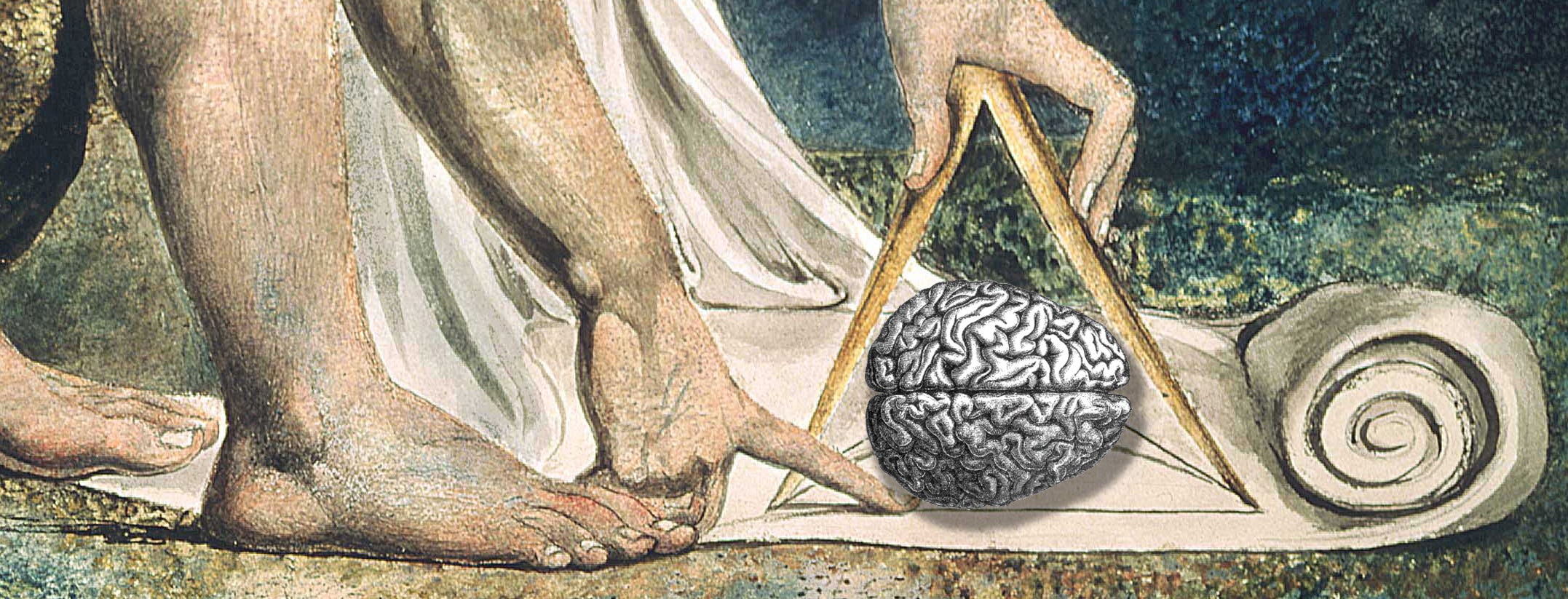
Text written by human, not AI. Illustration: Sir Isaac Newton painted by William Blake, with a brain in photomontage.
Marius Bild, Matteo Fadel, Yu Yang, Uwe von Lupke, Phuillip Martin, Alessandro Bruno, and Yiwen Chu (2023), “Schrödinger cat states of a 16-microgram mechanical oscillator”, Science 380, 274-278 (2023). DOI:10.1126/science.adf7553
Henry Stapp, Jeffrey M. Schwartz, and Mario Beauregard (2004), “Quantum physics in neuroscience and psychology: a neurophysical model of mind–brain interaction”, Philosophical Transactions of the Royal Society, Series B doi:10.1098/rstb.2004.1598