
Free will and idealism

Free will is a philosophical problem that gets some otherwise sensible people saying very silly things, while the rest of us stare blankly at the question: Obviously, we have free will, but — how does it fit into our understanding of the nature of reality? The answer to the riddle was already available to us in the Advaita Vedanta, the 8th Century philosophical movement led by Adi Shankara. Easily accessible to Western minds, it was not.
Within the theory of mental monism, aka subjective idealism, the correct solution to the conundrum falls out as a natural consequence of some straightforward premises. And yet, even George Berkeley, the chief advocate of idealism in Western philosophy, did not see it. Dan Kolak is one of the few modern philosophers to get it.
Deniers of free will performed some astonishing mental contortions to present their theories of denial. ‘Compatibilism’ was the worst offender. Essentially the compatibilists threw the Law of Excluded Middle out of the window. This Law simply says that any given proposition, p, is either true or not true. There is no middle ground between true and not true. The compatibilists said yes, we have free will—but, no, we are completely determined. This is a clear case of doublethink that defies rational exposition. Related to the compatibilists are the ‘redefiners’, who want to redefine free will as something other than free will. For example if a chain of deterministic cause and effect runs through some agent X, then we can pretend it has free will. For example, consider these two cases: (a) You kick a robodog across the room. (b) The robodog decides to cross the room according to its programming. The latter is supposed to be free will because the behaviour resulted from something inside. This is rubbish. The robodog’s program was implanted by an external agent, namely the computer programmer. Its behaviour was determined by outside forces in both cases: either my boot, or the programmer’s fingers tapping out code on a keypad. There is no free will in either case, and it is ridiculous to suppose otherwise. Another absurdity is the legal argument: if we didn’t have free will then the notions of responsibility and guilt would be void, but we need them as supports of justice, so we have to pretend that we have free will while at the same time believing that we are deterministic meat-machines.
Benjamin Libet’s experiments
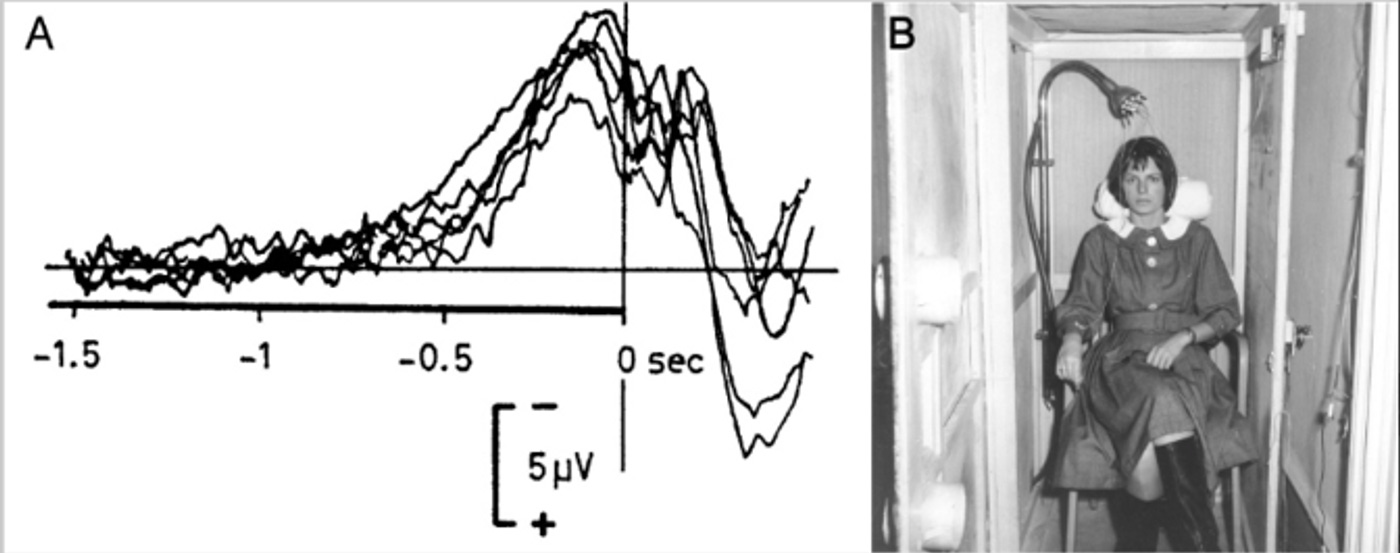
In the early 1980s, Professor Benjamin Libet at the University of California in San Francisco, conducted a series of experiments that supposedly tested whether we have free will. His results are very widely quoted as proof that free will is an illusion, and yet the experiments actually say nothing at all about free will.
In the most cited experiment, a subject has to press a button whenever s/he felt like it. Libet attempted to cross-reference the time of volition with the time at which the neural process of pressing the button started. For the former, he asked the subject to watch an dot moving around an electronic ‘clock’ display, and make a note of when "he/she was first aware of the wish or urge to act". Let’s call that the ‘Noticed Time’. At the same time, Libet would monitor the subject’s brain activity with an electroencephalogram (EEG), and note the start time of the electrical activity in the motor cortex that would lead to the finger press. He found that the electrical activity started about 300 ms before the Noticed Time. Libet, and his many followers, interpreted the result thus: the brain makes a decision to act and, a third of a second later, the mind picks up on this and mistakenly believes that it was responsible for the decision.
The obvious flaw in Libet’s experimental protocol is that he is not measuring the time of volition itself. He is recording when the subject becomes aware of the volition, but obviously the volition must precede the awareness of the volition. Duh.
The time-line is like this:
T=0
The conscious mind exercises volition to decide to press the button.
This flips a quantum superposition in a portal in the brain. (I have argued in earlier posts that this is in the DNA molecule.)
This triggers a sequence of electrical activity in the motor cortex lasting 500 ms.
T= approx. 250 ms
The clock reaches the Noticed Time
The visual signal proceeds from the retina to the visual cortex.
T=approx. 300 ms
The visual perception of the clock showing the Noticed Time enters the conscious mind.
An awareness of the forthcoming voluntary action enters the conscious mind.
T=approx. 500 ms
The finger presses the button.
An act of volition is not an item in the sensorium. It is an action of the subject, not an object of the subject’s awareness. There is no quale of volition. Just as the mind gains an awareness of sensory impressions entering the brain, so it also gains an awareness of incipient motor events. The mind does not perceive the volition itself, it perceives the result of the volition.
There is no way that anything like Libet’s experimental protocol will yield any information about the exercise of free will.
How can we tell when a conscious mind is active in the world?
To get a handle on this phenomenon, we have to go back to first principles. As I have argued in earlier posts, the conscious mind embodies itself in physical objects such as brains by, in effect, measuring and hence collapsing quantum wave functions in what I have called ‘portals’ in the brain. These nondeterministic events reveal the trace of a conscious mind.
This is the only test. Monitor a system (be it a brain, or an artificial computer) and see whether it exhibits meaningful, purposive behaviour that is steered by nondeterministic collapses of quantum wave functions.
Within the physical realm, that is the only way to tell whether a conscious mind is at work. Not by Libet’s pointless experiment that simply does not address the issue of free will.
Free will versus ‘random’ events
A riddle that challenges even those who acknowledge the reality of conscious minds is this: What is the difference between events that are produced by free will and merely random noise?
The massive prejudice in science towards regarding the physical world as the only game in town has led to a very strange concept of the ‘random’. In the physicists’ worldview, everything that happens is either determined from antecedent states and rigid laws of physics, or it happens by random chance. There is no third category. The same dichotomy, we are told, arises in the mental world. A mental event is either deterministic, driven by some laws of consciousness, or it is random chance. What precisely is free will supposed to be, if it is neither deterministic nor random?
Let us consider more closely … what does ‘random’ mean in the framework of idealism? In this framework, all that exists are conscious minds and everything that happens is a mental action. So, any so-called random event is actually a volitional act by some mind, but it is a disconnected mind, not a mind that is engaged in pursuing some purpose. The difference between a mental event that we would describe as ‘random’ and a mental event that we would describe as ‘free will’ is not absolute but a matter of degree. We tend to say that a pattern of events reveals a free will at work if it is meaningful or purposive. But those events are of precisely the same nature as events that we tend to call ‘random’ just because they are haphazard. Deterministic events are also mental actions, which were originally free in their inception but have been carried forward in time.
There is ultimately only one kind of mental event: whether we classify it as random or volitional depends entirely on context.
As I alluded in the beginning: this understanding of all events in the universe being driven by a mental force was found in the Advaita Vedanta. "Thou Art Brahman” and “Thou art that” are two of the Mahavakyas or ‘great sayings’, and they mean that everything that happens - be it ‘random’ or willed by a person, or determined by laws of nature - is an act of the universal consciousness, or Brahman.
We do have personal free will; and as we are numerically identical to Brahman, our actions are also the free will of Brahman. It all boils down to the same thing, really.
References
Libet, Benjamin; Gleason, Curtis A.; Wright, Elwood W.; Pearl, Dennis K. (1983). “Time of Conscious Intention to Act in Relation to Onset of Cerebral Activity (Readiness-Potential) – The Unconscious Initiation of a Freely Voluntary Act”. Brain. 106 (3): 623–642. doi:10.1093/brain/106.3.623.
Libet, Benjamin (1985). “Unconscious Cerebral Initiative and the Role of Conscious Will in Voluntary Action”. The Behavioral and Brain Sciences. 8 (4): 529–566. doi:10.1017/s0140525x00044903.
Illustration: The original 1964 experiment that discovered the readiness potential (Bereitschaftspotential) prior to voluntary finger flexion and one of the participants hooked up to an EEG. Photo from the original experimental setup used in Kornhuber and Deecke). Photo source: Lüder Deecke, Nature