
Agentic and non-agentic archetypes in the mental monism framework
Or: Why you can collapse a quantum wave function, but your chair can't

[Thanks to Marco Masi for challenging me to look into this question.]
According to the oldest interpretation of quantum mechanics (generally attributed to John von Neumann and Eugene Wigner), a superposition of quantum states is collapsed into a single state in an act of observation by a conscious mind. This certainly has a lot of plausibility. The Schroedinger wave function has no built-in means of making sudden jumps, so when a particle such as an electron strikes a detection device and is thereby decohered, the device becomes entangled and hence goes into superposition itself. No other physical system can trigger the collapse, as any such system just slips into the same superposition: the collapsing agent has to be something non-physical, and the conscious mind is the obvious choice. (The only competitor theory is ‘Many Worlds Interpretation’, which has the fatal flaw that is requires consciousness to be non-existent, or at best epiphenomenal.)
Fine. But, in the philosophical framework of idealism — which I have been advocating throughout these Substack posts — the real world consists exclusively of conscious minds. According to this theory, there is a vast background consciousness, a kind of mental operating system, than controls everything in the world except our free will. Following Berkeley’s nomenclature, this metamind (which he called ‘God’) comprises a great matrix of ‘archetypes’, which store (in some phenomenal form) all the information about each object. These archetypes supposedly operate like miniature minds. So, for example, my chair has an archetype within the metamind, which is rendered in my visual and tactile perceptions. So have the two-slit barrier and the detection device in the double-slit experiment. But that poses a problem. If idealism says that the distinct components of the two-slit experiment embody conscious minds—then, why don’t they collapse the wave function?
It appears that there are two kinds of archetypes: ones that can collapse a wave function and ones that can’t. My further speculation is that both of the two roles of collapse-by-consciousness in the brain—namely perception in the sensory cortex and action in the motor cortex—go together. That is, archetypes of the agentic class can generally trigger the collapse of a superposition in a portal: whether that power is used afferently or, under voluntary control, efferently probably just depends on where the portal is situated in the brain and in what flow of information processing it is embedded.
Of course, I realise that this looks like an arbitrary kludge to get the model to fit the facts, rather than something you’d expect from first principles, but I think it makes sense in retrospect. We have no idea when or how the metamind got started, but we might suppose that, at first, it just evolved some environmental structures using non-agentic archetypes, and then it budded off some agentic ones, which used the matrix of regular archetypes as a medium through which to communicate in a virtual three-dimensional world. Maybe the agentic archetypes got started as random mutations but then found they had a competitive advantage and multiplied in larger numbers. This is pure guesswork, but my point here is that we can a least imagine possible evolutionary pathways through which agentic archetypes could become common.
So the proposal is that passive, non-agentic archetypes just ‘go with the flow’, and accommodate entanglement with whatever superpositions come with it. But agentic archetypes, because they can act volitionally in the (virtual) world, need to be able to exert themselves and that can be done consistently only by collapsing superpositions. By ‘consistently’ I mean consistent with the laws of physics that are programmed into the physical construct.
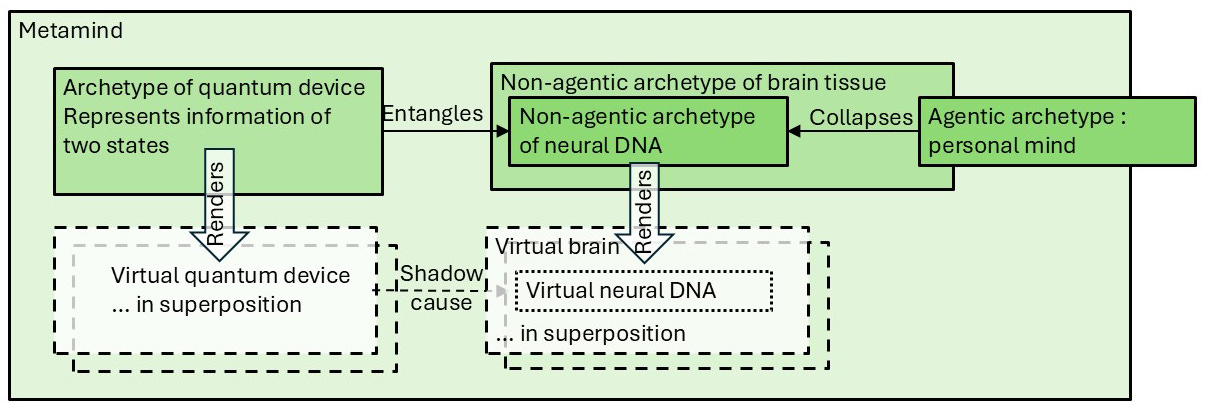
This diagram illustrates what happens when you observe the result of a quantum detection device such a radioactive decay. Within the physical construct there is a ‘shadow causation’, the device causing the observation. But in the actual causation, the non-agentic archetype of the device causes the non-agentic archetype of brain tissue to harbour a superposition; the agentic archetype of the personal mind then causes the superposition to collapse.
I remain troubled by the seeming inelegance of the hypothesis of two classes of archetypes, but as far as I can see there is no way to avoid it. On the one hand, we need the structural stability of non-agentic archetypes; on the other hand, the fact that our own brains embody volition shows that there must also be agentic archetypes at work. So it goes.
I really don’t know where, in the phylogenetic tree, agentic archetypes start embodying in living organisms. From anatomical and behavioural similarities, I’d wager that mammals are all conscious. Cephalopods plausibly might embody conscious minds (see eg Mather, 2008). Conceivably every DNA-based organism might carry consciousness, but I wouldn’t bet on it.
Even if an agentic archetype could collapse superpositions, could it also get into superposition itself? Well, only for the moment that it takes the archetype to detect the superposition and squash it. As it will be wanting to use its power of voluntary action to manipulate its environment (to acquire food, shelter, mates, and so on), there does not seem to be any advantage in going into a passive mode.
This will all firm up once we get to engineering artificial archetypes, and building artificial conscious minds. These could be embodied in machines, or—in principle—disembodied. BTW Disembodied agentic archetypes are reported in the non-academic literature. In studies of lucid dreaming, there is evidence that some some dream characters are sentient (Foley 1989). In DMT experiences, there are frequent reports of encountering seemingly autonomous entities (see e.g. Luke & Spowers, 2022). In the literature of chaos magic, there is a concept of ‘servitor’, which is essentially a free-ranging agentic archetype (see e.g Hine, 1991).
References
Jennifer A. Mather (2008), “Cephalopod consciousness: Behavioural evidence”, Consciousness and Cognition, 17(1), 37-48. https://doi.org/10.1016/j.concog.2006.11.006
Paul Foley (1989). “Consciousness and Abilities of Dream Characters Observed during Lucid Dreaming”, Perceptual and Motor Skills, 68(2), 567–578. https://doi.org/10.2466/pms.1989.68.2.567
David Luke and Rory Spowers (2022), DMT Entity Encounters, Simon & Schuster.
Phil Hine (1991), Chaos Servitors: A User Guide.
The distinction between agentic and non-agentic archetypes is elegant and addresses a real problem in idealist frameworks. If everything is mind, why doesn't everything collapse the wave function?
One question the framework raises for me: if agentic archetypes collapse superpositions through volitional acts, we still need to explain what determines which outcome they select. The collapse is attributed to consciousness, but the selection mechanism remains open.
An alternative framing: what if consciousness doesn't collapse anything? If the underlying structure is already complete and atemporal, containing all outcomes simultaneously, the agentic archetype doesn't select an outcome. It finds itself correlated with a branch that was always already definite.
The chair's archetype and the mind's archetype would then differ not in their power to collapse, but in their capacity to have a perspective at all. Non-agentic archetypes have no vantage point. Agentic ones do. And it's the vantage point, not the collapse, that makes the difference.
Well, I'm in a quantum superposition of agreement and disagreement. ;)
On the one hand, the metamind approach resonates with me. It is actually similar to my approach of universal consciousness manifested as a universal quantum field.
On the other hand, as you know, I don't agree with the idea that QM compels us to embrace the von Neumann–Wigner interpretation as a solution to the measurement problem, which ultimately leads to scarcely credible forms of idealism where we must believe the whole universe was in superposition and suddenly came into existence only once there was a conscious observer looking at it. Frankly, it makes no sense to me. My standpoint is that the metamind alone does all the heavy lifting, also in and through our individual minds and brains. This perspective doesn't require reality to collapse into existence only once one of us brings it about. Moreover, I would refine your theory by explaining more clearly how a conscious collapse could circumvent the objection that we should observe statistical deviations from the predictions of QM beyond the so-called "psi experiments". In my theory this is not necessary in the first place: one can have agency in the world with agential collapse but without postulating violations of the statistics predicted by the Schrödinger equation plus the Born rule, or invoking violations of energy conservation. Furthermore, the distinction between "physical" and "unphysical" is not clear. Saying that the physical is "unreal" and only the mental is "real" merely shifts the question from "un/physicality" to "un/reality" without really solving it. These are the points I expect referees to raise.
In any event, I'm fully on board with the archetypal understanding of reality and the metamind–QM connections. I think we are both, together with others, working towards something that is laying the groundwork for a paradigm shift in our scientific understanding of reality.